
How to Write a Peer Support Progress Note That Actually Says Something
- The Mindful Peer

- May 1
- 4 min read

You are sitting at your computer right now, staring at a blinking cursor.
You just finished an incredible, impactful session with a peer. There were tears, there were breakthroughs, and there was a genuine moment of connection. But now, you have to distill that hour of complex human experience into a paragraph for an electronic health record.
If you are feeling stuck, you aren't alone. Documenting peer support is notoriously difficult. You are trained to connect as a human being, not to analyze as a clinician. Yet, your notes need to prove that valuable, goal-oriented work is happening.
So, how do you bridge the gap? How do you write a note that satisfies the auditors, respects the peer’s journey, and actually means something to the next person who reads it?
It starts with understanding one fundamental difference.
Describing What Happened vs. Describing What Mattered

The most common trap in writing progress notes is acting like a court stenographer. We tend to write down a chronological play-by-play of the meeting.
Describing what happened sounds like this:
"Met peer at the coffee shop. We got lattes and sat by the window. Peer talked about her mom for a long time and said she was stressed out. I shared my story about my own mom. Peer said she felt better. We planned to meet next Tuesday."
This note tells us where you were and what the topic was, but it tells us absolutely nothing about recovery, skills, or progress.
Describing what mattered sounds like this:
"Met with peer in the community to work on her goal of reducing isolation. Peer identified her current relationship with her mother as a primary trigger for her anxiety. PSS (Peer Support Specialist) shared lived experience regarding setting family boundaries. Peer explored three new boundary-setting phrases she can use this week. Peer reported feeling a decrease in immediate anxiety and increased confidence in managing family interactions."
See the difference? The first note describes a hangout. The second note describes an intentional, goal-directed peer support intervention.
To get from the first to the second, you need a reliable structure.
The 4-Part Structure of a Meaningful Note
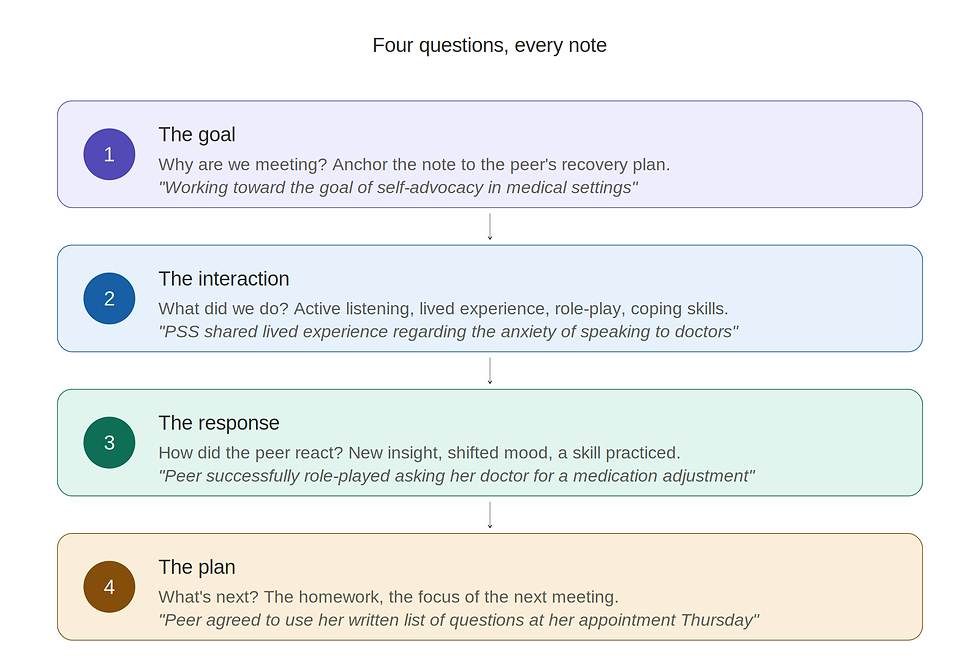
You don't need a degree in clinical documentation to write a great note. You just need to answer four specific questions, every single time. (Many agencies use formats like BIRP or GIRP—this plain-English structure maps perfectly to those).
1. The Goal (Why are we meeting?)
Never start a note without anchoring it to the peer's overarching recovery plan. What specific goal are you working on today?
Example: "Working toward the goal of self-advocacy in medical settings..."
2. The Interaction/Intervention (What did we do?)
What specific peer support tools did you use? Did you use active listening, share lived experience, role-play a conversation, or explore coping strategies?
Example: "PSS utilized active listening and shared lived experience regarding the anxiety of speaking to doctors."
3. The Response (How did the peer react?)
What happened because of your interaction? Did the peer gain a new insight? Did their mood visibly shift? Did they practice a skill?
Example: "Peer successfully role-played asking her doctor for a medication adjustment, overcoming her initial hesitation."
4. The Plan (What's next?)
What is the homework, or what is the specific focus of the next meeting?
Example: "Peer agreed to use her written list of questions at her appointment on Thursday. PSS and peer will follow up on Friday to debrief."
3 Real-World Examples
Let's look at how this structure comes together in three common peer support scenarios.
Example 1: The "Community Integration" Outing
The Scenario: You went to the grocery store with a peer who experiences severe social anxiety.
The "What Happened" Note: Went to Kroger with John. He was nervous but he got his groceries. I helped him bag them.
The "What Mattered" Note: Met with peer in the community to support his goal of independent living and managing social anxiety. Upon entering the store, peer expressed feeling overwhelmed and exhibited signs of panic. PSS validated these feelings and guided peer through a 5-4-3-2-1 grounding exercise. Peer successfully regulated his breathing, completed his shopping list independently, and reported feeling proud of his resilience. Plan: Meet next week to practice using the public bus system.
Example 2: The "Venting" Session
The Scenario: You met in an office. The peer spent 45 minutes furious and venting about an unfair landlord.
The "What Happened" Note: Sarah was really mad today. Her landlord is ignoring her calls about the leaky roof. I listened to her vent for an hour. She calmed down eventually.
The "What Mattered" Note: Session focused on peer's goal of maintaining stable housing. Peer arrived in a state of high distress regarding an unresponsive landlord. PSS provided a safe space for emotional expression and utilized empathetic listening. Once peer de-escalated, PSS and peer collaboratively brainstormed self-advocacy steps. Peer drafted a formal, objective email to the landlord during the session. Plan: Peer will hit 'send' tomorrow morning and update PSS via text.
Example 3: The "Relapse Prevention" Call
The Scenario: A peer called you on the phone, experiencing cravings, and you talked them through it.
The "What Happened" Note: Talked to Mark on the phone. He wanted to drink because he had a bad day at work. I told him to remember his recovery. He said he would go to a meeting instead.
The "What Mattered" Note: Provided telephonic support regarding peer's goal of maintaining sobriety. Peer reported experiencing strong cravings triggered by workplace stress. PSS shared lived experience regarding navigating sudden cravings and prompted peer to review his WRAP (Wellness Recovery Action Plan). Peer successfully identified attending a mutual-aid group as his immediate coping strategy. Peer’s tone shifted from agitated to resolved by the end of the call. Plan: Peer will attend the 7 PM meeting tonight and PSS will check in tomorrow at noon.
The Bottom Line
Your notes are the bridge between the human magic of peer support and the clinical reality of the behavioral health system.
When you find yourself stuck at the screen, take a deep breath. Stop trying to remember every detail of the conversation, and simply ask yourself: What was the goal, what skill did we use, and what progress was made? Answer those three things, and you've written a note that truly matters.


Comments